


There is a kind of exhaustion that sleep does not seem to fix. You wake up heavy, motivation has disappeared and things you normally care about suddenly feel strangely distant. Even small tasks require negotiation. You might retreat into bed, scroll for hours or find yourself thinking, “What’s the point?” This experience is sometimes described as dorsal collapse, a state in which the nervous system moves away from mobilisation and towards shutdown.
It can be frightening because we tend to interpret changes in energy psychologically. We assume we have become lazy, lost our discipline or are somehow going backwards. Yet sometimes the body is telling a simpler story: it has been mobilised for too long and no longer has the resources to keep fighting.
Collapse is not necessarily the absence of a survival response.
Sometimes it is the survival response.
The Different Nervous System States
Polyvagal theory offers a useful framework for understanding these shifts through three broad autonomic states.
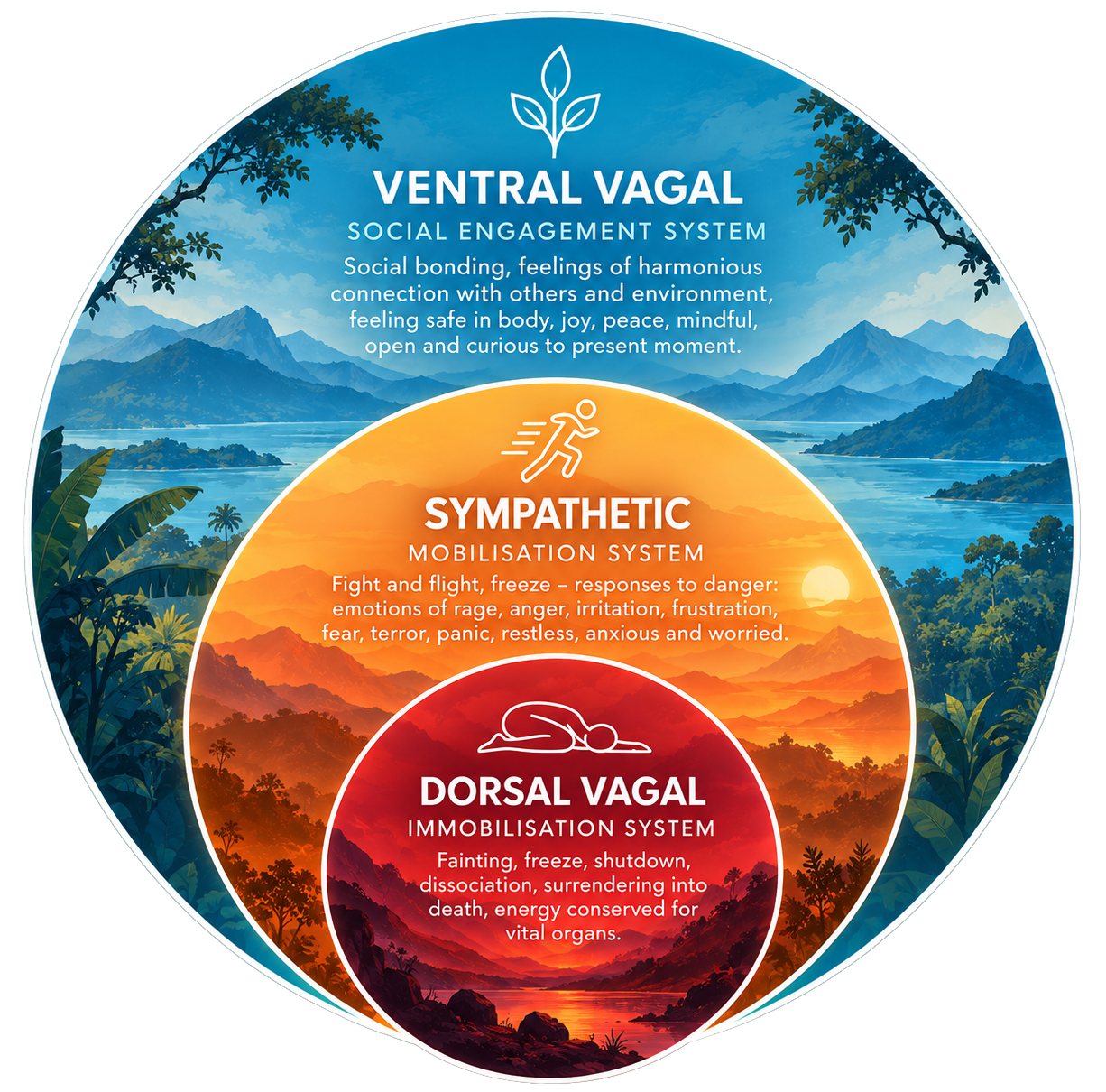
Ventral Vagal regulation is associated with safety, connection and social engagement. We feel grounded, open and curious, allowing us to experience joy, meaningful relationships and a sense of presence without feeling overwhelmed.
Sympathetic mobilisation prepares the body to respond to perceived threats through fight or flight. Energy rises, often accompanied by anxiety, anger, restlessness or hypervigilance. Prolonged activation can leave us constantly on edge, unable to relax.
Dorsal vagal shutdown emerges when threats feel overwhelming or inescapable. Rather than mobilising, the nervous system shifts towards conservation, bringing heaviness, withdrawal, numbness or dissociation.
Each state serves a protective function; with healthy regulation allowing movement between them.
What Is Dorsal Collapse?
Fight and flight depend upon an assumption that action might work. There is still somewhere to run, something to fight or some possibility that increased effort could change what is happening.
Dorsal collapse can emerge when mobilisation no longer seems useful or prolonged stress exceeds our capacity to sustain it. Instead of producing more energy, the system reduces expenditure.
Think of a circuit breaker rather than a broken machine.
From an evolutionary perspective, immobilisation is an ancient survival strategy. When escape becomes impossible, some animals freeze or become profoundly still. Human beings rarely experience this response so dramatically, yet traces of the same physiology can appear through withdrawal, lethargy, dissociation, heaviness and reduced motivation.
The internal shift can be confusing. Yesterday you were desperately trying to solve everything; today you barely care. Intense productivity gives way to hours in bed. Anxiety may disappear, not because the problem has been resolved, but because the nervous system has moved from mobilisation into conservation.
When Shutdown Looks Like Depression
Dorsal collapse can resemble depression. Both may involve low energy, withdrawal, reduced motivation and a desire to retreat from life, yet there can be important differences.
A shutdown state may have a clearer relationship with overwhelm. Someone has been coping, pushing or remaining hypervigilant for an extended period and then crashes. Beneath the exhaustion there may still be emotion, longing and a desire for connection, even when there is little capacity to act upon them. As regulation returns, energy can begin returning too.
Major depression is a clinical condition that can involve persistent low mood or loss of interest alongside changes in sleep, appetite, concentration, energy, self worth and hope. The two experiences can overlap, which means dorsal collapse should not become a convenient way of diagnosing ourselves out of depression.
The distinction is useful because not every period of shutdown means something is fundamentally wrong with us.
Sometimes the nervous system is exhausted.
Why Pushing Through Can Make Things Worse
Our culture has a predictable response to low motivation: push harder. Get out of bed, go to the gym, make a plan and sort yourself out.
For someone already cycling between sympathetic overactivation and collapse, pressure can recreate the conditions that produced the shutdown. Another burst of mobilisation temporarily feels like recovery; eventually the borrowed energy runs out and the body drops again.
A brutal pattern develops: push, perform, exhaust, collapse, shame yourself and repeat.
Coming out of dorsal collapse requires something subtler. The nervous system needs enough mobilisation to begin moving again alongside enough safety that movement does not become another demand.
The image I prefer is thawing. Frozen ground does not need to be attacked; it needs warmth.
Coming Out of Dorsal Collapse
Movement can be one of the simplest places to begin, although intensity matters. A ten minute walk, gentle stretching, slow yoga or standing outside in daylight introduces mobilisation without demanding a full sympathetic surge. The message is not “perform”; it is “movement is possible”.
Sensory cues offer another route back. Warm water on the body, sunlight on the skin, a hot drink, softer lighting or wrapping yourself in something comfortable may sound trivial compared with the complexity of trauma. The autonomic nervous system, however, responds to embodied information. Safety is not only something we understand intellectually; the body has to experience it.
Connection matters for the same reason. Dorsal states often pull us towards isolation, yet complete isolation can deepen the retreat. Co regulation does not require forcing yourself into intense socialising. Sitting with someone safe, hearing a familiar voice or having a conversation where nothing is expected of you may provide enough relational contact for the system to begin orienting outwards again.
Cognitive demands can also be scaled down. Instead of confronting an entire backlog, complete one contained task. Wash the dishes, reply to one message or walk around the block. The activity itself matters less than experiencing agency returning.
Reconnection
The goal of nervous system work is not to remain permanently ventral. Healthy regulation involves flexibility: mobilising when action is required, resting when energy needs replenishing and returning towards connection when the threat has passed.
Problems emerge when survival states become places we live rather than states we visit.
Understanding dorsal collapse gives us another way of meeting those periods when everything seems to disappear beneath us. Instead of immediately asking, “What is wrong with me?” we can become curious about what happened before the collapse.
How long had I been pushing?
What had I been carrying?
Where had my body already been signalling that it was reaching capacity?
Perhaps the heaviness is not evidence that you have stopped caring about your life. Perhaps your nervous system has simply stopped believing that more effort is the answer.
Sometimes the way back begins not with forcing yourself to rise, but creating enough safety that something inside you wants to rise again.
Related Articles


LET'S EXPLORE WORKING TOGETHER
Book a free 45-minute Clarity Call to:
•Clearly identify the core blocks you’re experiencing.
•Gain clarity on what’s causing your current challenges.
• Explore how my holistic approach can support your growth.
•Discover if we have the right connection for meaningful, lasting change.
