
Some days, modern day life can feel unbearable. The weight of disconnection, division, and chaos in the world is hard to ignore. It’s not just social media and access to information making it louder.
Things have changed.
In many ways, they’ve become worse. Loneliness is rising. People feel more polarised, less trusting. There’s a nostalgia now for the 90s and early 2000s, a time that felt slower, simpler, more human.
The world feels broken; and maybe it is.
But maybe… it’s also exactly what it’s meant to be.
There’s an old idea that in the face of madness, we always have two choices: to laugh or to cry. When life becomes absurd, outrageously painful, or impossibly unfair, we find ourselves standing on a strange edge. We either collapse under the weight of it all, or we crack a smile at the madness. Sometimes, both.
This is not about denial or bypassing. It’s about perspective.
The comedy tragedy of life is not something we solve.
It’s something we learn how to hold.
Absurdity as Truth
There have been moments in my life when situations have been so ridiculous, outrageous and unfair that the only response I could find was laughter – “How can it get more ridiculous than this?!’ The absurdity was too big to process in any other way.
These moments reveal something deeper. That logic, control, and reason are not enough to carry the human experience. We need myth, madness and humour. The absurd is not a glitch in the system. It is the system. It exposes the truth that life does not always make sense; and maybe it’s not supposed to.
Laughter in these moments becomes its own kind of sanity.
It’s a refusal to collapse.
A way to stay in the room with the pain without being swallowed by it.
The Story of the Three Laughing Monks
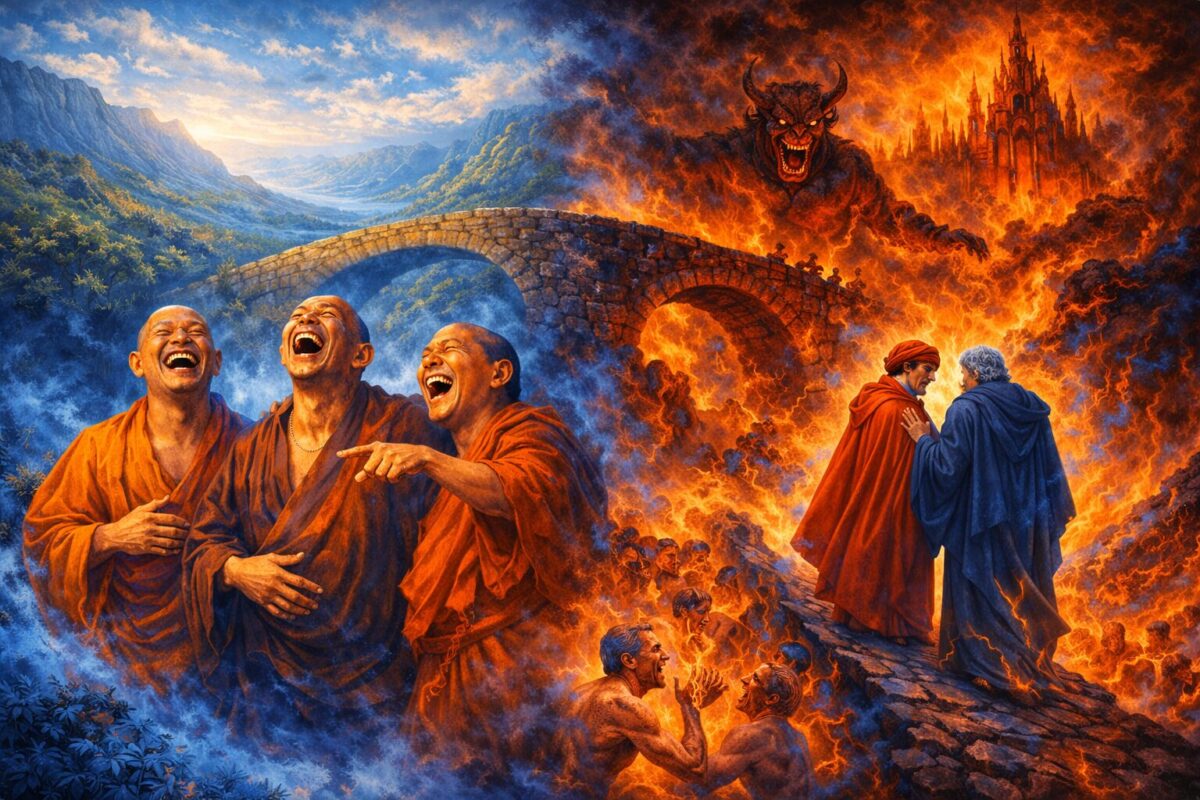
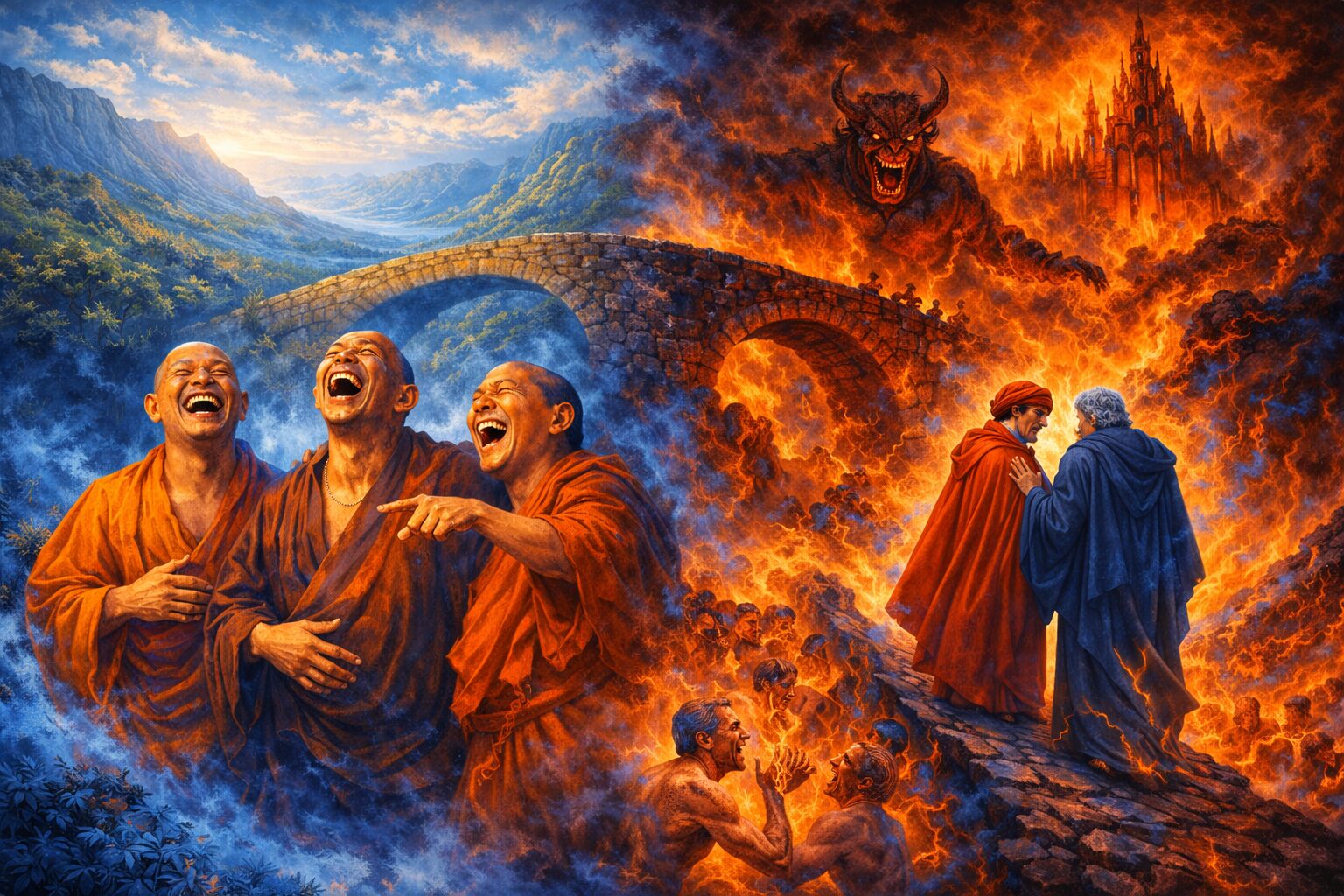
There’s an old Chinese legend of three monks. They never preached, wrote scriptures or gave instructions. Instead, they travelled from village to village, doing just one thing everywhere they went.
They laughed.
They would enter a town, stand together in the marketplace, and erupt into deep, unrelenting laughter. Their joy was contagious. Crowds would gather. Children would giggle. Elders would smile. Something shifted, and people remembered something ancient within themselves.
The monks would leave, never having said a word. Just laughter.
When one of them died, the villagers gathered, wondering what the remaining two would do. Would they mourn? Would they speak? But instead, the two monks laughed even louder than before. When asked why, they said, “He got there first. He played the joke best. He left before us.”
That’s the spirit of this article.
That even death is not exempt from the cosmic punchline.
That laughter is not denial; it’s transcendence.
It’s remembering that no matter how heavy it gets, something in us can still access light.
The Comedy Tragedy of Being Human
To be human is to feel both the beauty and the brutality of life at once. Joy and grief don’t arrive on separate trains. They often sit in the same carriage. We laugh at funerals, cry at weddings. We carry love and loss in the same breath. This is the texture of a full life; one that doesn’t shy away from extremes.
The theatre of existence is rich with contradiction. We build systems to protect the vulnerable, then elect leaders who harm them. We search for truth and then argue over it endlessly. We crave connection while clinging to our walls. It’s both comical and heartbreaking.
And it doesn’t mean we give up.
It means we learn to work with the contradictions instead of against them.
Sacred Fool: The Wisdom in the Ridiculous
In myth, the fool isn’t just comic relief. The fool is sacred. He’s the one who can speak truth to the king without losing his head. He’s the one who can dance through madness and survive. He doesn’t play by the rules of order and reason.
He plays by the rules of reality as it actually is; unruly, strange, and unpredictable.
There’s deep wisdom in the fool. He reminds us that control is an illusion. That our plans, our righteousness, our attempts at perfection are always slightly off. The fool laughs because he sees that we are all clinging to something that isn’t real.
In the moments when life breaks us open, when the story no longer makes sense, the fool whispers,
“This too is part of it.”
And somehow, that laughter becomes medicine.
The Personal Is Also Ridiculous
Each of us carries our own comedy tragedy.
We fall for the wrong people.
We say the wrong thing at the worst time.
We try to control what was never ours.
We hurt people we love.
We try our best and still get it wrong.
There’s something both devastating and deeply funny about this. When we step back far enough, we begin to see our lives like a play. Messy, imperfect, full of unexpected plot twists.
It doesn’t mean our pain isn’t real. It just means it’s not the only thing that’s real.
Sometimes what heals isn’t analysis, but distance. The ability to zoom out and say, “What a ride.” That perspective softens shame and makes us human again.
Dante’s Descent: The Shift in Perspective
In The Divine Comedy, Dante begins his journey lost in a dark wood, frightened, confused, and unsure how to move forward.
From the inside, it’s tragedy. He’s ashamed, disconnected, and caught in something that feels final. That’s how life often feels when we’re inside it. We can’t see the shape. Only the pain.
What makes Dante’s story powerful is that he doesn’t escape hell; he walks through it. Every soul he meets is trapped in a loop of their own making. Most believe their suffering is someone else’s fault. There’s no laughter in hell, only mis-recognition. No one sees the larger pattern they’re caught in.
The turning point is not escape, but understanding. Dante begins to name the patterns, see the mechanics of suffering, and hold it within a larger view. What felt unbearable starts to become intelligible. Still painful, but no longer senseless.
That’s where the comedy begins; not in jokes, but in meaning. The shift is subtle but profound.
Tragedy narrows, comedy expands.
The same life, viewed with more perspective.
The same pain, held in a wider frame.
Choosing to Laugh
This isn’t about making light of real suffering. It’s about recognising that in the face of powerlessness, there’s still a choice. To spiral deeper into despair, or to shift into a different perspective. Sometimes it’s forced on us, other times we can choose it.
Laughter in this context is not mockery; it’s reverence. It’s the soul saying, “Even this, I will find a way to hold.” That’s how we stay open without breaking and return to the present after reality pulls the rug.
And sometimes, it’s the only thing that keeps us going.
Final Reflection: Holding Both
The world is worse in many ways. The pain is real, the grief is justified. And yet, maybe it’s exactly this mess that gives us something to work with and respond to.
Without chaos, we lose our reason to grow.
Without the cracks, we forget to create.
Maybe the world is a joke. A hard one. But one we’re here to keep telling, in new forms, with fresh meaning. Because that’s what humans do; we laugh, we cry, we rebuild.
We hold contradictions in our hands and call it life. Not because it’s perfect, but because it’s ours.
And in that, maybe we are not so lost after all.